80% automated risk evaluations | 50% faster credit limit decisions
HighRadius Automated Credit Scoring Software helps businesses reduce default risk by replacing outdated scoring models with AI-driven risk evaluation. Built with predictive credit scoring capabilities, the solution enables businesses to lower bad debt exposure by up to 20%, accelerate credit limit decisions by 50%, and automate 80–90% of routine credit risk evaluations. By combining internal payment behavior, external credit intelligence, and configurable risk models, HighRadius helps businesses proactively identify risk and reduce up to $57 million in annual credit exposure.


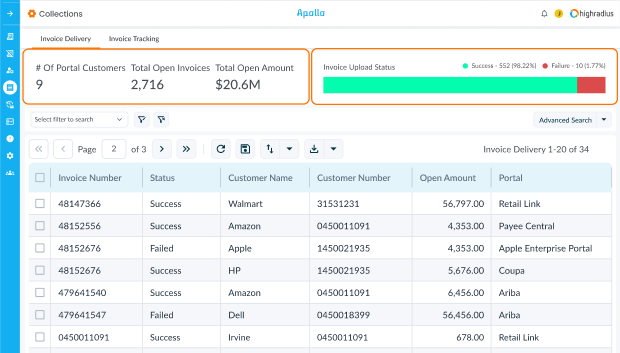
HighRadius automated credit scoring software helps organizations replace static bureau scores and manual spreadsheet models with AI-powered scoring agents that continuously evaluate customer risk using internal payment behavior, external redit intelligence, and predictive analytics.
Online credit applications automatically collect customer financial data, trade references, bank references, and supporting documents while integrating with 35+ global credit agencies to centralize risk inputs for automated credit scoring.
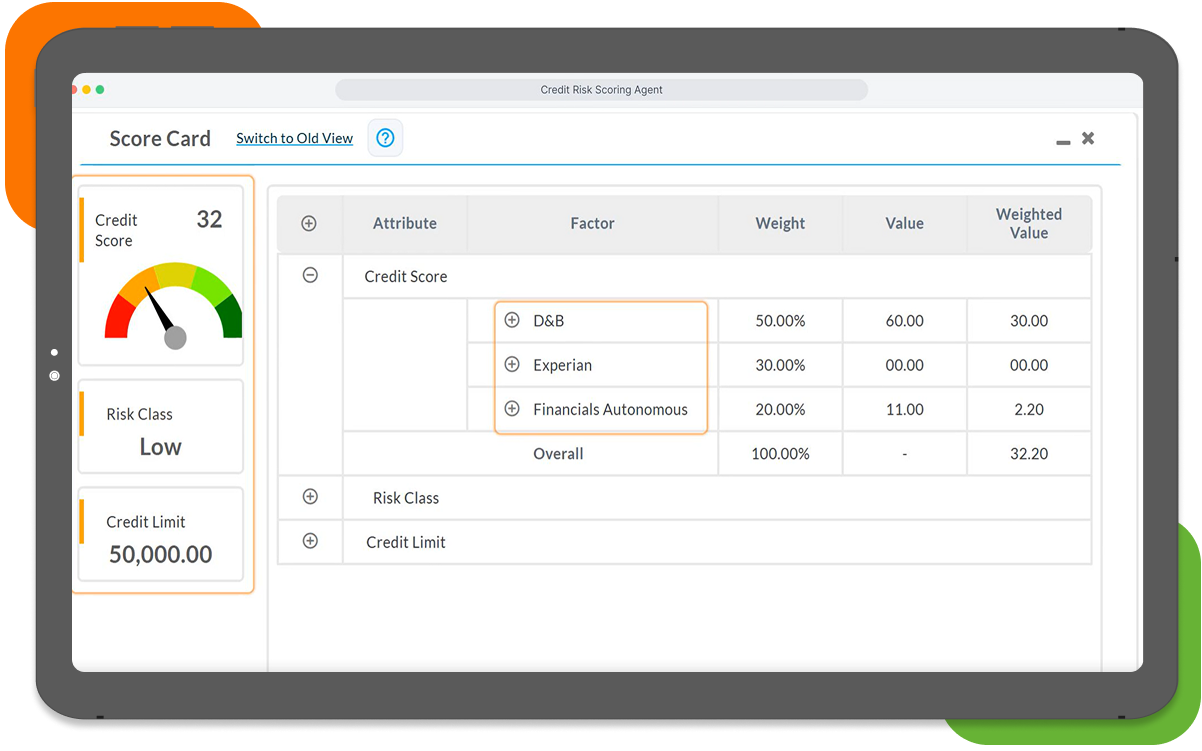
AI-powered credit scoring models combine bureau data, ERP payment behavior, financial statement analysis, and configurable scorecard weightings to deliver explainable, data-driven credit risk evaluations tailored to your business policies.
Automated credit scoring software generates risk classifications and recommended credit limits using predictive scoring algorithms, enabling teams to automate 80–90% of low-risk evaluations while accelerating credit decisions by up to 50%.
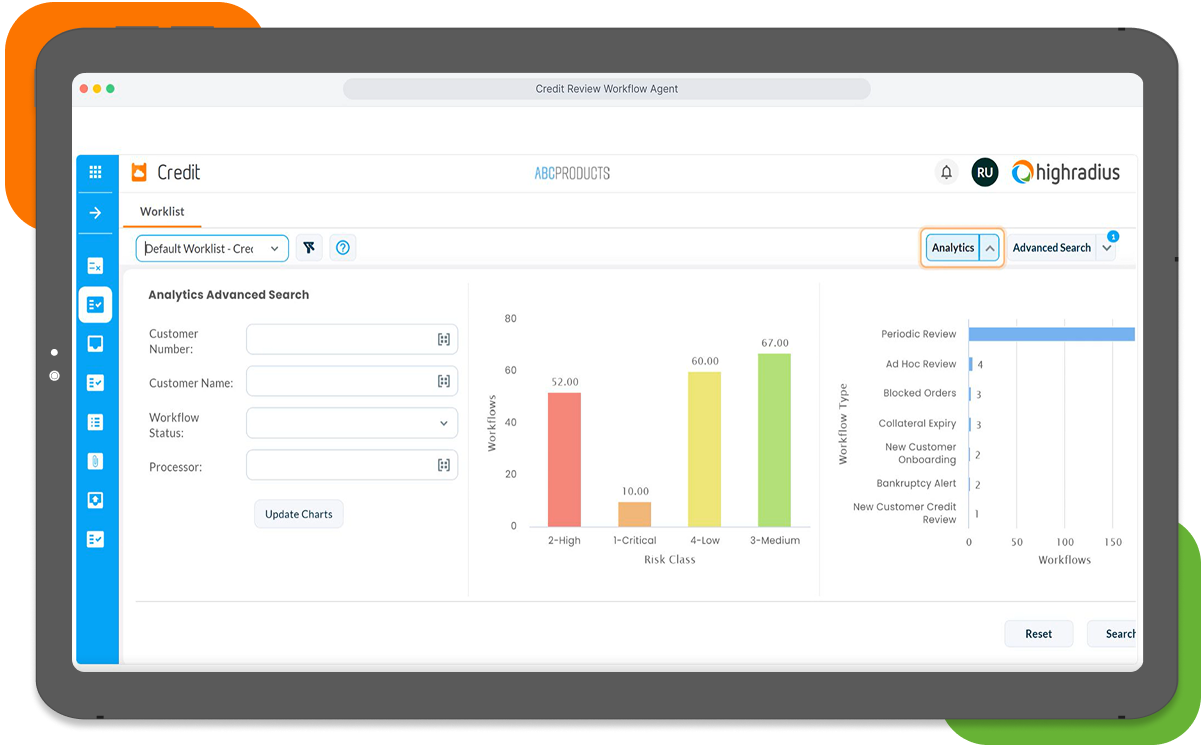
Continuous risk monitoring detects changes in payment behavior, bankruptcy events, and emerging financial distress signals to proactively update credit scores, helping businesses reduce bad debt exposure by up to 20%.
HighRadius credit scoring software uses Agentic AI to automate risk evaluation, continuously monitor customer health, and deliver faster, more accurate credit decisions using real-time internal and external data.
By replacing manual reviews and static scoring models with Agentic AI, HighRadius credit scoring software helps finance teams improve analyst productivity, proactively manage risk, and scale credit operations with confidence.
2–3× More credit reviews per analyst
Automated credit scoring software eliminates manual financial spreading, data gathering, and spreadsheet-based software credit scoring processes. Analysts can focus on high-risk exceptions and strategic credit analysis rather than administrative tasks.
70–80% Automation of credit evaluation tasks
Automated credit scoring software orchestrates scoring, risk reviews, alerts, and credit limit recommendations throughout the customer lifecycle. Agentic AI reduces reliance on fragmented systems, emails, and manual credit scoring workflows.
Real-Time Risk Visibility and Early Warning Signals
Real-time automated credit scoring continuously evaluates payment behavior, utilization spikes, and adverse financial events as they occur. Credit teams gain proactive visibility into customer exposure and can intervene before risk impacts revenue or working capital.
Scalable Credit Operations Without Increasing Headcount
Credit scoring software automates periodic reviews, credit application processing, and low-risk evaluations, enabling finance teams to scale credit operations, improve analyst productivity, and support business growth without increasing headcount.
Build a mathematically reliable foundation using automated credit scoring
Replace static scorecards with predictive risk intelligence using AI algorithms
Convert scoring outputs into exposure control actions
Detect deterioration before losses accumulate
Automate credit scoring and decisioning across complex supply chains with real-time exposure tracking and risk evaluation.
Read MoreScale credit scoring for high-volume customers using dynamic risk models based on payment behavior and demand cycles.
Read MoreAccelerate credit approvals and monitor risk continuously for large, high-transaction customer bases with automated software credit scoring.
Read MoreEvaluate credit risk for subscription and service models using behavioral data, contract exposure, and dynamic scoring.
Read MoreBuilt for enterprises managing high deduction volumes across multiple ERPs, retailer portals, and global shared services environments.
Designed for lean finance teams scaling deduction operations without increasing headcount or manual research effort.
Native integration with SAP ERP for credit score software enables real-time credit scoring, automated credit decisions, and sync exposure tracking across credit score systems.
Read MorePre-built connectors for NetSuite in credit score software support seamless credit scoring workflows, automated risk evaluation, and unified credit data management.
Read MoreDeep integration for credit scoring software with Microsoft Dynamics enables automated credit scoring, centralized credit analysis, and consistent decisioning across business units.
Read MoreIntegrated credit scoring software for Oracle ERP environments, enabling real-time risk monitoring, scoring accuracy, and scalable credit decisioning.
Read MoreHighRadius' automated credit scoring features builds solid partnerships and offers robust integration capabilities by integrating with 110+ banks, 40 credit agencies, 50+ ERPs, and 15+ billing systems globally.
Ready to Connect HighRadius with Your ERP?
Download ERP FactsheetChoose the right tools that empower your credit risk decisions.
Download Free ScorecardLearn how our agentic AI-led O2C reduces past-dues by 20% and accelerates customer onboarding.
Download Data SheetBalance credit risk within the consumer goods industry with a five-step roadmap.
Download eBookCredit score software is a system that calculates, monitors, and continuously updates customer credit risk using AI-powered scoring models. Unlike static bureau scores or spreadsheet-based evaluations, modern automated credit scoring software combines internal payment behavior, ERP exposure data, financial statements, and external bureau intelligence to generate dynamic credit scores, Probability of Default (PD), Risk Class, and recommended credit limits..
Advanced credit scoring software replaces manual credit evaluations and periodic reviews with agentic AI that continuously analyzes emerging risk signals. When payment behavior deteriorates, utilization spikes, or bureau ratings change, predictive scoring models automatically recalibrate customer risk profiles, enabling finance teams to proactively adjust credit limits, prevent blocked orders, and reduce bad-debt exposure before losses accumulate.
Conventional credit scoring software depends on periodic reviews and static bureau updates that quickly lose relevance. Agentic AI-driven credit scoring AI software recalibrates Probability of Default (PD), Risk Class, and Credit Scores using live payment behavior, exposure levels, and external risk signals.
Outcome: Credit risk assessment reflects current reality, not historical snapshots.
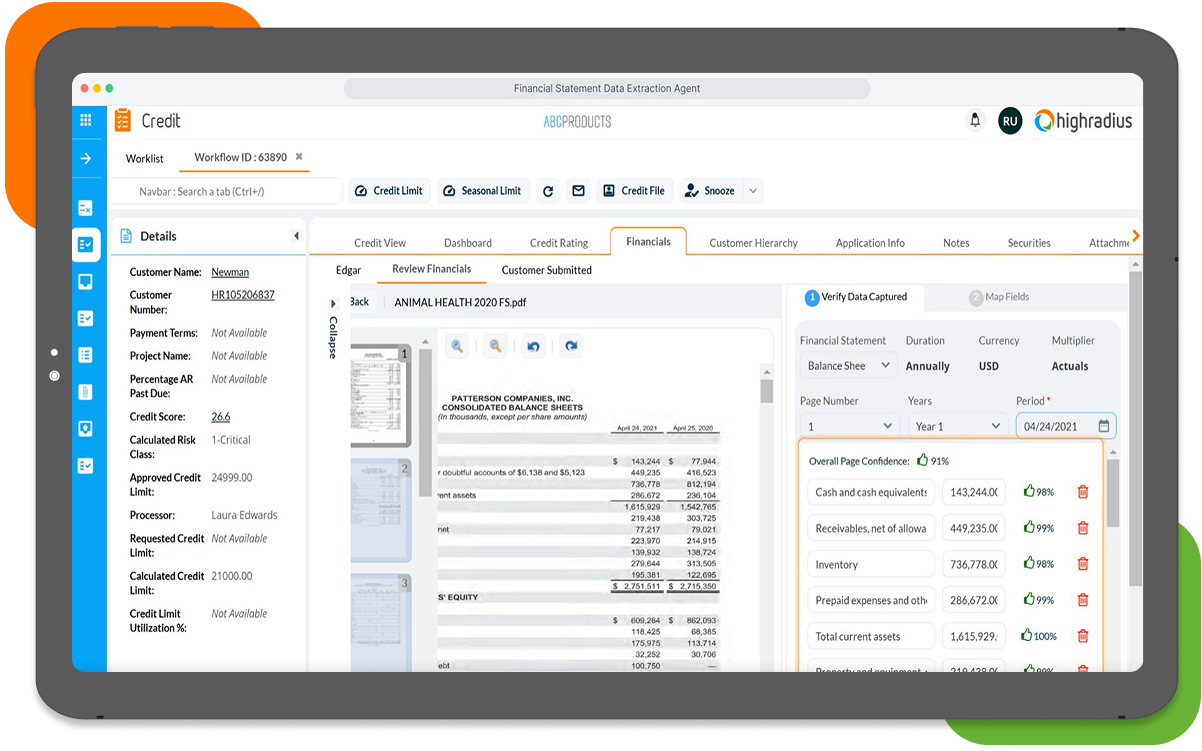
Legacy credit analysis software requires analysts to manually extract ratios, reconcile bureau data, and maintain spreadsheet-based scorecards. Our credit score software automates financial statement spreading, bureau data extraction, and scoring calculations across integrated credit score systems.
Outcome: Credit teams eliminate operational drag without compromising analytical rigor.
Traditional software credit scoring models rely heavily on fixed scorecards and limited bureau variables. Our credit scoring engine evaluates behavioral payment trends, utilization shifts, financial ratios, and bureau intelligence simultaneously using AI-driven scoring models.
Outcome: Early detection of default risk and behavioral deterioration.
Manual reviews and fragmented credit scoring tools introduce delays as portfolios and transaction volumes expand. Agentic AI-enabled credit scoring platforms automate scoring, monitoring, and credit limit recommendations while enforcing policy thresholds.
Outcome: Higher decision throughput with consistent scoring logic.
Unlike traditional credit scoring software that applies static scorecards, agentic AI continuously recalibrates credit scores using live payment behavior, exposure shifts, and external risk signals. Scoring evolves as customer risk conditions change, not just during onboarding or scheduled reviews. This transforms software credit scoring from a periodic evaluation tool into a dynamic risk intelligence system.
Manual software credit scoring relies on backward-looking data snapshots and analyst-driven calculations. Credit scores degrade quickly when financial conditions or payment behavior shifts. Automated credit score software applies AI models that evaluate behavioral trends, exposure volatility, and financial signals to maintain continuously accurate credit scores.
| Capability | Manual Credit Score Software | Automated Credit Score Software |
|---|---|---|
| Score Calculation | Built in Excel using static scorecards and manually updated financial ratios. | AI-driven credit scoring engine calculates Probability of Default (PD), Risk Class, and Credit Score dynamically. |
| Data Inputs | Limited to periodic bureau pulls and manually collected documents. | Aggregates bureau, ERP, behavioral, and financial data via credit scoring AI software. |
| Risk Freshness | Scores updated quarterly or annually, missing emerging risk signals. | Real-time recalibration within the credit scoring platform based on payment and exposure changes. |
| Consistency | Scores vary by analyst interpretation and spreadsheet logic. | Standardized scoring logic enforced across enterprise credit score systems. |
| Handling Thin Files | Private or new customers often declined due to limited bureau data. | Alternative and behavioral data modeled using automated credit scoring tools. |
| Scalability | Portfolio growth requires more analysts and manual spreading effort. | Credit scoring software scales evaluations without proportional headcount increase. |
| Auditability | Score changes and assumptions are difficult to reconstruct. | Full traceability maintained by AI-enabled credit analysis software. |
| Risk Detection | Deterioration is often identified after delinquency occurs. | Early-warning alerts generated by predictive credit scoring engine models. |
Not all credit scoring software is built equally. Many tools calculate scores; few deliver predictive accuracy, continuous monitoring, and enterprise-grade governance. Here are a few things to consider when selecting a credit scoring software.
Move from backward-looking ratings to forward-looking risk intelligence
Prioritize software credit scoring that models Probability of Default (PD), not just bureau-based ratings. The right credit scoring engine should combine behavioral, financial, and exposure variables to generate forward-looking credit scores.
Build scoring accuracy on unified, decision-grade credit data
Ensure the credit analysis software integrates bureau, ERP, financial, and payment behavior data. Modern credit scoring software must eliminate fragmented inputs that distort scoring accuracy.
Adapt scoring models to your unique risk strategy
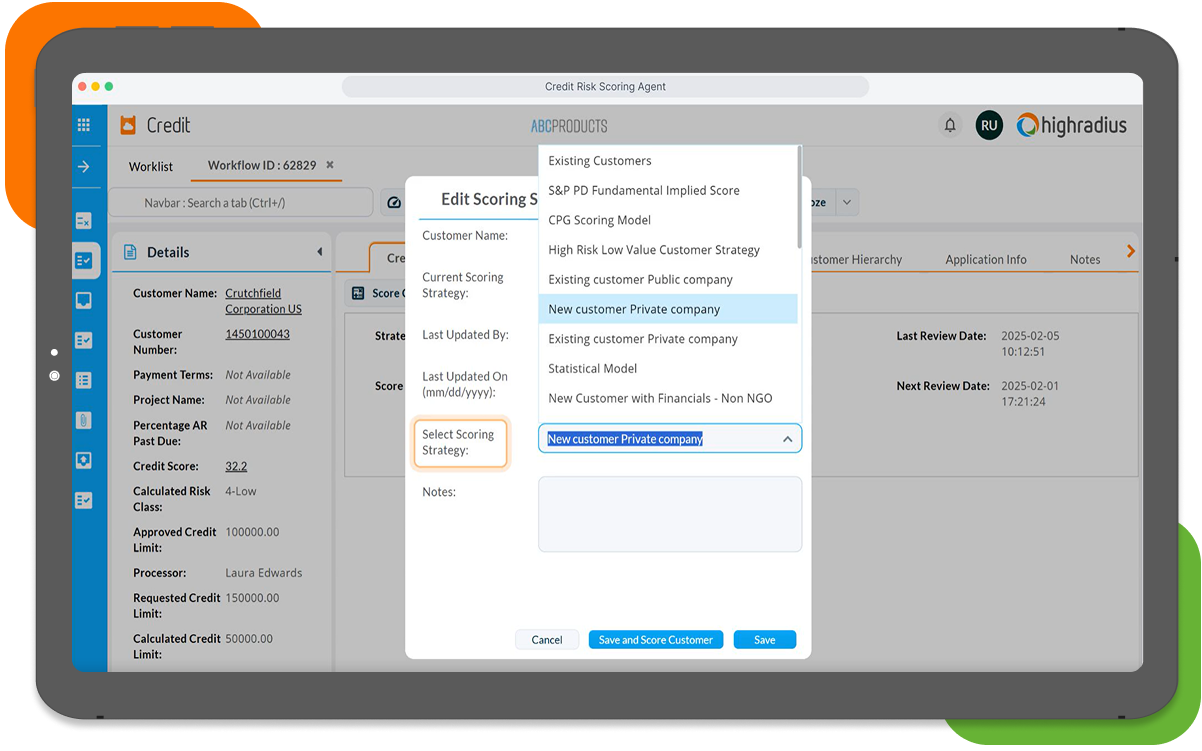
Avoid rigid vendor-defined scoring logic. An effective credit scoring tool allows teams to configure models, weightages, thresholds, and segment-specific scorecards.
Ensure scores reflect current risk, not periodic snapshots
Choose a credit scoring AI software that updates scores continuously, not quarterly. Risk signals such as payment delays, utilization spikes, or financial deterioration must trigger dynamic recalculation.
Score beyond traditional bureau limitations
Evaluate whether the credit scoring platform can assess private or thin-file customers. Advanced credit score systems incorporate alternative financial and behavioral data beyond traditional bureau reports.
Make every credit score transparent and defensible
Enterprise credit score software must provide transparent scoring logic and reason codes. Complete audit trails ensure every score, override, and model update remains defensible.
Traditional credit scoring methods were built for periodic evaluation, not real-time risk volatility. As customer exposure, payment behavior, and financial conditions shift daily, static scoring models create decision blind spots.
Spreadsheet-driven credit scoring and rule-heavy analysis led credit scoring tools depend on manual updates, fragmented bureau pulls, and periodic reviews. Risk signals—payment deterioration, utilization spikes, financial stress, often surface too late. Credit teams spend more time reconciling data than interpreting risk, while exposure accumulates outside the visibility of outdated credit score systems.
Our credit scoring AI software continuously ingests bureau data, ERP exposure, and behavioral signals to recalibrate scores dynamically. Agentic AI agents detect early risk drift, trigger reviews, and recommend credit limit actions before losses or blocked orders occur. Credit decisions become predictive, mathematically consistent, and explainable, without dependency on spreadsheets or delayed human intervention.
Leading enterprises are rethinking credit and collections with AI—automating everything from credit scoring and blocked order prediction to high-risk account follow-ups and dispute resolution. In just 6 months, they’ve seen 20% drop in bad debt, and unlocked over $2M in additional cash flow.
Book A Discovery CallCredit scoring software uses AI-powered scoring models to evaluate customer credit risk using payment behavior, financial statements, ERP data, and external bureau intelligence. It helps businesses automate credit evaluations, assign credit limits, monitor risk continuously, and reduce bad debt exposure through data-driven credit decisions.
Automated credit scoring combines internal payment history, ERP exposure data, financial statements, and credit bureau information to generate dynamic risk scores. AI models continuously monitor risk signals and update credit scores in real time, enabling faster evaluations and proactive credit management.
Consumer lending commonly relies on FICO® and VantageScore® models to assess borrower risk. In B2B environments, organizations increasingly use automated credit scoring software that incorporates payment behavior, financial data, and bureau intelligence to generate customized credit risk assessments.
Automated credit scoring improves consistency, reduces manual reviews, and helps organizations identify emerging risks earlier. By replacing spreadsheets and static evaluations with AI-driven scoring models, businesses can accelerate credit decisions, reduce bad debt exposure, and scale operations efficiently.
HighRadius provides an AI-driven credit scoring and risk assessment platform that scales from lean finance teams to complex global credit operations.
Growth-Focused Finance Teams: Automates spreadsheet-driven onboarding, credit scoring, and low-risk approvals using AI-driven workflows, online applications, and real-time monitoring to accelerate onboarding and improve analyst productivity.
Global Enterprise Credit Operations: Standardizes credit scoring, blocked-order management, and risk monitoring across multiple ERPs, regions, and business units using predictive AI, continuous monitoring, and centralized policy orchestration.
Consumer credit scoring evaluates individual borrowers using standardized bureau models. B2B credit scoring assesses business customers using payment history, trade references, financial statements, ERP data, and configurable risk policies to determine creditworthiness and appropriate credit limits.